Can AI Replace Live Musicians? Here's What Really Matters
AI has already changed the way people create music. It can generate songs, write lyrics, produce vocals, build instrumental arrangements, and do things that would have required hours of work from musicians and producers not that long ago.
But there's a question I haven't heard enough people asking.
What happens when AI has to walk on stage?
It's one thing for artificial intelligence to create a song or reproduce the sound of a band. It's another thing entirely to entertain a room full of people, get them singing, keep them dancing, and create a moment they'll remember long after the music stops.
As a working musician and performer, that's the part of the AI conversation I find especially interesting.
Because when we talk about AI and music, I think we need to look beyond the music itself.
We need to talk about the performance.
The AI Conversation Has Mostly Been About Making Music
For the last several years, much of the debate surrounding AI and music has centered on recorded music, songwriting, production, and copyright.
Tools such as Suno have made it possible for people to generate complete musical recordings from text prompts. AI can also help with mixing, mastering, instrumental parts, and vocal production.
These developments raise legitimate questions. What happens when AI-generated music is trained on existing recordings? Who owns the result? How should musicians be compensated when their work contributes to the systems generating new music?
Those are important discussions, and the legal questions are still evolving. I'm not a lawyer, so I'm not going to pretend to have all the answers.
But there's another question that matters to those of us who make a living performing in front of people.
What happens when a client can get the music without hiring the musicians?
Imagine that it's five years from now. A client is planning a wedding reception and considering hiring a five-piece band.
Now imagine that the alternative is an AI-powered entertainment system that can generate almost any song, provide vocals and backing tracks, accommodate requests instantly, maintain perfect timing, and operate for hours at a fraction of the cost.
No travel expenses. No hotel rooms. No meals. No coordinating five different schedules.
If the music sounds nearly as good, why would the client pay more for a live band?
That's a question worth taking seriously.
But I think it misses something important.
What Is the Client Actually Paying For?
Let's take a familiar song: Don't Stop Believin'.
A live band can play it. A DJ can play the recording. An AI system can potentially reproduce a version of it, too.
The song itself isn't necessarily what separates these options.
So what makes someone hire a live band?
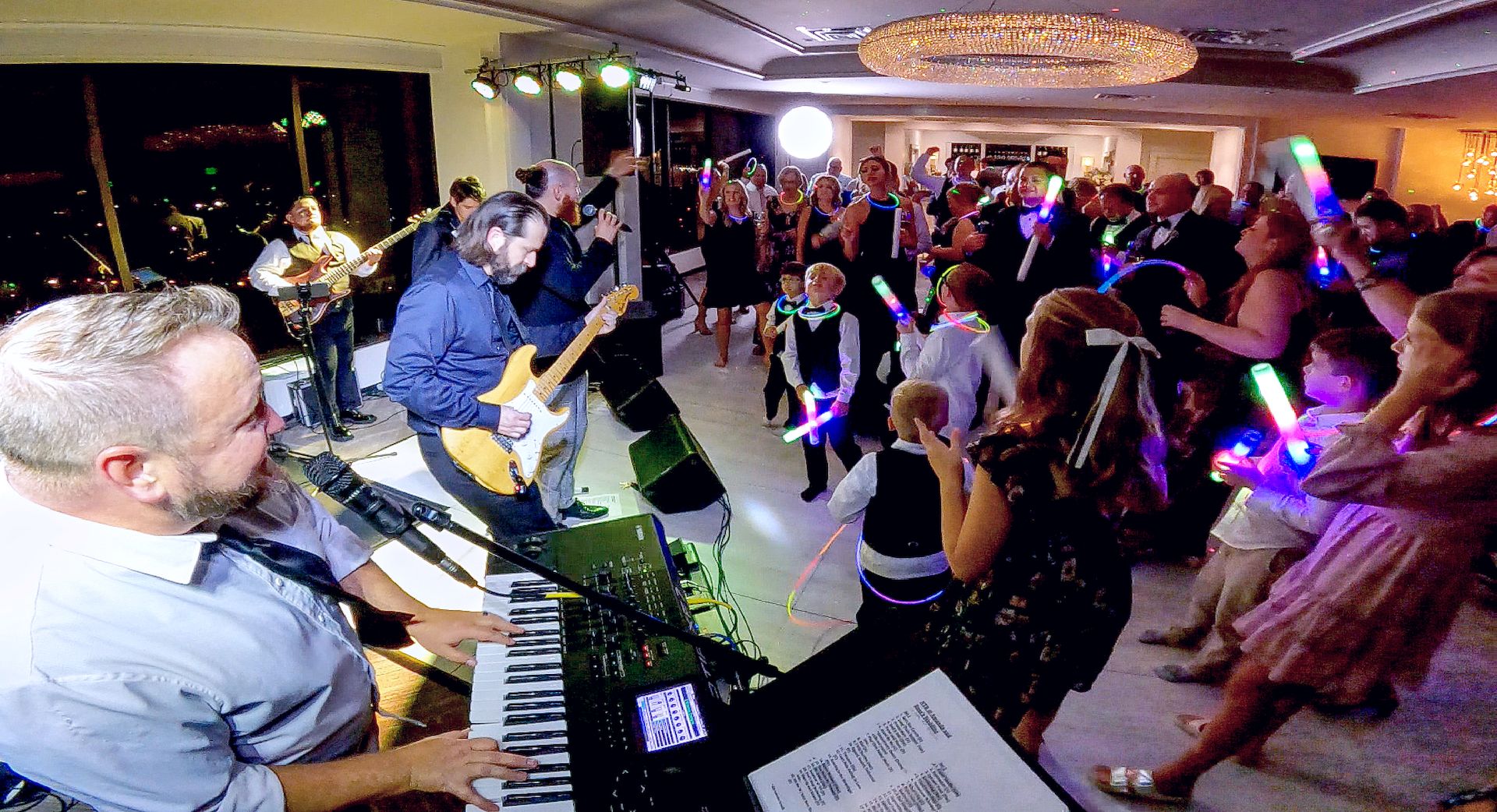
Maybe they want to see people performing. Maybe they want a singer who gets the entire room singing along. Maybe they want guests on the dance floor, musicians interacting with the crowd, and spontaneous moments that become stories people tell for years.
The client isn't simply paying for a collection of songs.
They're paying for an experience.
And that's where the conversation changes.
Music is part of your product. The experience you create is your product.
At Danny Robertson Music, I talk a lot about the different elements that make up a live performance. It's not just about what the audience hears. It's also about what they see and what they feel.
The music matters, of course. You need to be good at what you do. But a technically perfect performance doesn't automatically make a room full of people feel connected to you.
Think about the performers you've watched who can command a room. They know how to communicate with an audience, build excitement, recognize a moment, and make people feel like they're part of the show.
That ability is valuable.
And it may become even more valuable as technology makes the music itself easier to produce.
The Things That Make a Live Performer Different
What does a human performer bring to the stage that an AI-generated soundtrack doesn't automatically provide?
1. Human connection
Eye contact. A smile. A singer acknowledging someone in the crowd. A band responding to the excitement of the room.
These interactions help an audience feel like they're participating in something rather than simply listening to something.
2. Personality
People don't hire entertainers solely because they can reproduce a song. They also respond to the personality of the performer.
Your humor, style, confidence, stage presence, and the way you interact with people help define the experience you provide.
3. Spontaneity
Live performances rarely go exactly as planned, and that's part of the fun.
Someone requests an unexpected song. A guest starts a singalong. A moment on the dance floor inspires a change of direction.
Experienced performers recognize these opportunities and respond to them.
4. Emotion
Music can be emotional on its own, but performers have the ability to communicate those emotions directly to an audience.
A singer can make a lyric feel personal. A keyboard player can build anticipation. A band can take a room from casual conversation to an all-out dance party.
The notes are only part of the equation.
5. Making the audience part of the event
The best entertainers don't treat the audience like spectators who happen to be in the room.
They give people reasons to participate.
They encourage singing, dancing, cheering, laughing, and sharing the moment with the people around them.
That interaction is a major part of what makes live entertainment different.
Can AI eventually imitate some of these behaviors? Perhaps. Technology is moving quickly, and I wouldn't claim to know exactly where it will lead.
But musicians shouldn't overlook the value of these skills while focusing exclusively on the technology.
AI Might Become a Tool for Better Live Performances
Here's where I think the conversation gets interesting.
Instead of asking only whether AI will replace musicians, what if we ask how musicians could use AI to improve their shows?
Consider a few possibilities.
Using AI as an additional band member
Imagine that you perform as a three-piece band but can't afford to hire a drummer for every gig.
Backing tracks or AI-assisted musical tools could help you fill out the arrangement and deliver a bigger sound without necessarily adding another musician to the payroll.
This isn't an entirely new idea. Musicians have been using sequencers, backing tracks, and electronic instruments for years.
AI could expand the options available to performers who want to create a fuller musical experience with the resources they have.
Preparing a better setlist
Building a setlist is more complicated than putting together a list of songs you know how to play.
You have to think about the audience, the event, the timing, the energy of the room, and how each song connects to the next.
AI can help you brainstorm song choices, organize material around a theme, identify potential medleys, and build a starting point for your setlist.
You still need to use your experience and judgment. But the right tools could reduce preparation time and help you consider options you might have missed.
Handling the details around a gig
There's also a business side to performing.
Communicating with clients, organizing song requests, planning set times, preparing event information, and following up after a performance all take time.
AI may help streamline some of these tasks, giving musicians more time to focus on practicing, improving their shows, and booking better opportunities.
The point isn't to use AI for everything.
It's to identify the tasks where it can genuinely help you work smarter.
What If AI Could Read the Room?
Now let's take that idea a little further.
Imagine a future system that uses cameras and other available data to help evaluate what's happening during a performance.
Is the dance floor filling up or emptying out? Are people responding to the music? Is the energy building, or is the audience losing interest?
What if you could use that information to make better decisions about what to play next?
You might tell the system that the room is losing energy and ask for a new direction. It could suggest songs based on your catalog, the event, and the information available about audience response.
This is a hypothetical example of where the technology could go, not a claim that a dependable, fully autonomous system already does all of this.
But the underlying concept is familiar to experienced performers.
We already read the room.
We notice when people start dancing. We recognize when a song isn't connecting. We know when it's time to change direction, bring the energy up, slow things down, or encourage people to participate.
The challenge isn't simply identifying what's happening.
It's understanding what to do about it.
AI may eventually become a useful assistant in that process. Even then, a performer who understands the audience and knows how to create an experience will have an important advantage.
We've Had This Conversation Before: Remember MIDI?
If you've been around live music for a while, you might remember the introduction of MIDI in the early 1980s.
MIDI, or Musical Instrument Digital Interface, created a standardized way for electronic musical instruments and compatible equipment to communicate musical performance data.
It changed what musicians could do with keyboards, synthesizers, sequencers, and computers.
It also contributed to familiar fears about technology replacing musicians.
If a keyboard and sequencer could reproduce drum parts, did we still need drummers? If one musician could control multiple instruments electronically, would bands need as many players?
Electronic instruments and backing tracks did change the way some music was made and performed. Some musicians adapted their setups, while others continued to focus on traditional instrumentation.
But the availability of MIDI didn't make live musicians irrelevant.
A drummer isn't valuable only because they can produce a particular rhythm. Their feel, dynamics, timing, interaction, and response to the other musicians are part of what they bring to a performance.
The same principle applies to other performers.
Technology can reproduce or automate certain parts of a job without necessarily reproducing the entire value of the person doing it.
AI could follow a similar path. It may replace some tasks, change certain jobs, and create new ways to perform. It may also create real challenges for working musicians.
The lesson isn't that technology has nothing to worry us about.
It's that we should pay attention to what technology changes and what still makes us valuable.
The Competition Might Not Be AI Versus Humans
Here's the possibility I find most interesting.
The future might not divide performers into two groups: humans and AI.
It might divide them into performers who learn how to use new tools effectively and performers who choose not to.
That doesn't mean everyone needs to adopt every new technology. A tool is only worthwhile if it serves your goals, fits your show, and improves the result.
But musicians who use AI to prepare more efficiently, explore new arrangements, improve their business systems, or make better-informed decisions could find themselves with additional opportunities.
At the same time, performers who rely entirely on their musical ability while neglecting their stage presence, audience engagement, and overall show may find themselves competing in a tougher market.
If clients can access good music cheaply and easily, what other reasons will they have to hire you?
That question is worth asking now, regardless of how quickly AI advances.
What Musicians Should Focus on Right Now
You don't need to predict the future of AI to start improving your position as a performer.
Here are four things you can work on today.
1. Improve your stage presence.
Think about how you look, move, communicate, and interact with the audience. Don't assume that playing your instrument well automatically makes you entertaining.
2. Learn to read the room.
Pay attention to the audience instead of focusing exclusively on your next song. Notice what's working, what's falling flat, and when you need to change direction.
3. Create moments people remember.
Think beyond the setlist. How can you encourage participation, build excitement, create emotional connections, or make an ordinary event feel special?
4. Explore tools that make your work easier.
Experiment with AI where it makes sense. Use it to brainstorm, organize, plan, and handle repetitive tasks. Then bring your experience and creativity to the decisions that matter.
None of these steps requires you to become an AI expert.
They require you to think more deliberately about the value you bring to the stage.
So, Can AI Replace Live Musicians?
My answer is a maybe.
AI could replace certain musical parts, automate some tasks, and change what clients expect from live entertainment. There may be situations where a client chooses an inexpensive automated option instead of hiring musicians.
We shouldn't dismiss those possibilities.
But replacing the music isn't necessarily the same as replacing the performance.
People hire entertainers for the energy, personality, interaction, and memories they help create. They want guests to dance, sing, laugh, participate, and feel like they're part of the event.
If you can deliver that experience consistently, you have something valuable to offer.
And as technology evolves, the performers who understand that value will be in a better position to adapt.
Your show isn't just your music. It's a performance.
At Danny Robertson Music, my goal is to help musicians, singers, bands, and performers develop the skills that turn musical ability into a more engaging, memorable, and successful live show.
Because the goal isn't simply to play the right notes.
It's to become the performer you're meant to be.
What Do You Think?
Can AI eventually replace live musicians? Will it become a useful tool that makes performers better? Or will the human experience always give live entertainment an advantage?
Be the Performer You Are Meant to Be!
Join us to start performing with confidence, purpose, and fun... one email at a time.
When you signup, you will get regular email updates with free content and product offers.